
A cracked resin statue or a snapped miniature arm doesn’t mean the piece is done for. Cured resin bonds well with several adhesive types, and the right choice depends on what broke, how it broke, and what you need the repair to look like once finished.
We tested and researched the best glue for resin across the categories that actually matter for resin work: cyanoacrylate (super glue), two-part epoxy, UV resin, and polyurethane adhesive.
Our Top Picks at a Glance:
- Gorilla Super Glue Gel for everyday repairs
- Gorilla 2-Part Epoxy for the strongest hold
- Akisey Rechargeable UV Resin Repair Kit for jewelry and fine detail work
Let’s get to the details!
Can You Actually Glue Resin? Understanding Which Adhesives Actually Work
What glue works on resin?
Four adhesive families cover almost every resin repair:
- CA glue (super glue): cyanoacrylate adhesives that set in seconds and work well on clean breaks
- Two-part epoxy: a resin and hardener mixed together, used for gap-filling and heavier structural repairs
- UV resin: stays liquid until exposed to UV light, then cures hard in seconds to minutes, useful for jewelry and fine detail
- Polyurethane adhesive: expands slightly as it cures and bonds well across dissimilar materials, though it’s less common for fine resin work
Can cured resin be glued successfully?
Yes. Epoxy resin, UV resin, polyurethane resin, SLA resin, and most cast resins can all be repaired once fully cured. The surface takes adhesive well as long as it’s clean and free of mold release residue or dust.
One distinction worth making early: fresh, uncured resin is not an adhesive. If you pour new resin onto a break, it needs full cure time before it holds any real strength, and it won’t grip a glossy cured surface the way a proper adhesive will. Use resin as a filler for gaps, and glue as the actual bond.
Important Crafting Note: Uncured, liquid resin is not an adhesive. If you pour fresh liquid resin onto a break, it requires a full cure cycle before holding strength. If you are learning how to make a resin lamp or complex castings, always use proper adhesives for structural assembly and reserve liquid resin for filling voids.
The most common situations where people glue resin
- Repairing broken resin statues and figurines
- Fixing resin miniatures and tabletop models
- Reattaching 3D-printed resin parts
- Repairing resin jewelry, including pendants and rings
- Filling chips and hairline cracks
- Bonding resin to wood, metal, acrylic, or glass
- Restoring handmade resin crafts, including lamps and coasters
The 8 Best Glues for Resin We’ve Tested and Recommend
We selected these based on bond strength, ease of application, working and curing time, compatibility with cured resin, user reviews, and overall value for the price.
Akisey Rechargeable UV Resin Repair Kit (Best UV Repair Kit)
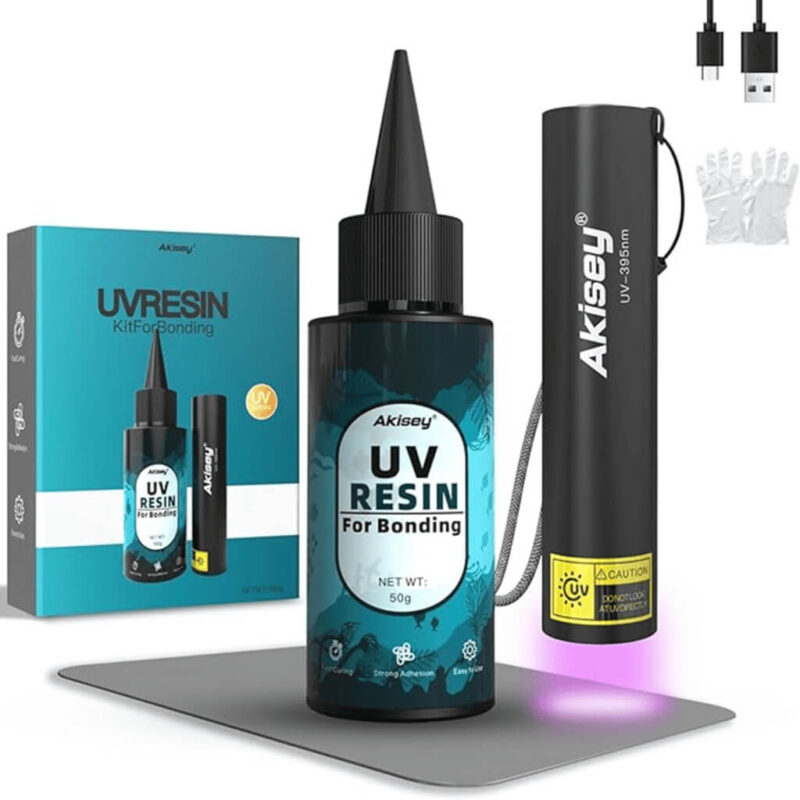
If you’re looking for the best glue for resin jewelry, miniatures, or transparent repairs, the Akisey Rechargeable UV Resin Repair Kit is one of the most versatile options available. Unlike traditional adhesives, it remains liquid until exposed to UV light, giving you complete control over positioning before the bond cures.
- Pricing: From $8.99, available on Amazon
- Adhesive type: UV-curing resin
- Bond strength: High for transparent or semi-transparent bonds; not rated for heavy structural loads.
- Working time: Stays liquid indefinitely until exposed to UV light, so there’s no rush to reposition parts.
- Full cure time: Cures in 5 to 10 seconds under the included 395nm, 1300mW UV flashlight.
- Finish: Clear, high transparency, no yellowing after cure.
- Waterproof or water-resistant: Water-resistant once cured.
- Best for: Jewelry makers, hobbyists doing detailed repairs on miniatures, and anyone who wants to reposition a piece before committing to a bond. Skip it if you’re repairing an opaque, load-bearing break where a visible glue line doesn’t matter but raw strength does.
- Use cases: resin miniatures, resin statues, jewelry, DIY resin crafts, resin models, mixed materials
- Compatible materials: epoxy resin, UV resin, polyurethane resin, plastic, wood, metal, acrylic, ceramic, glass (best results when at least one surface is transparent, since UV light needs to reach the resin to cure it)
What buyers on marketplaces and our team think of this resin glue
- From our team’s POV: The biggest advantage of UV resin isn’t necessarily its strength. It’s the control it gives during assembly. Because the adhesive doesn’t begin curing until exposed to UV light, you can carefully position small decorative parts before locking everything into place. That’s a significant advantage when repairing jewelry, transparent castings, or intricate resin miniatures where precise alignment is important.
- From buyers’ POV: They onsistently praise the fast curing time because it eliminates the need for clamps or overnight waiting. The most common limitation is also expected: UV resin won’t cure properly in shadowed areas or wherever the UV light can’t reach, making it less suitable for deep joints or opaque repairs.
Gorilla Super Glue Gel (Best Multi-Purpose Resin Glue Gel)
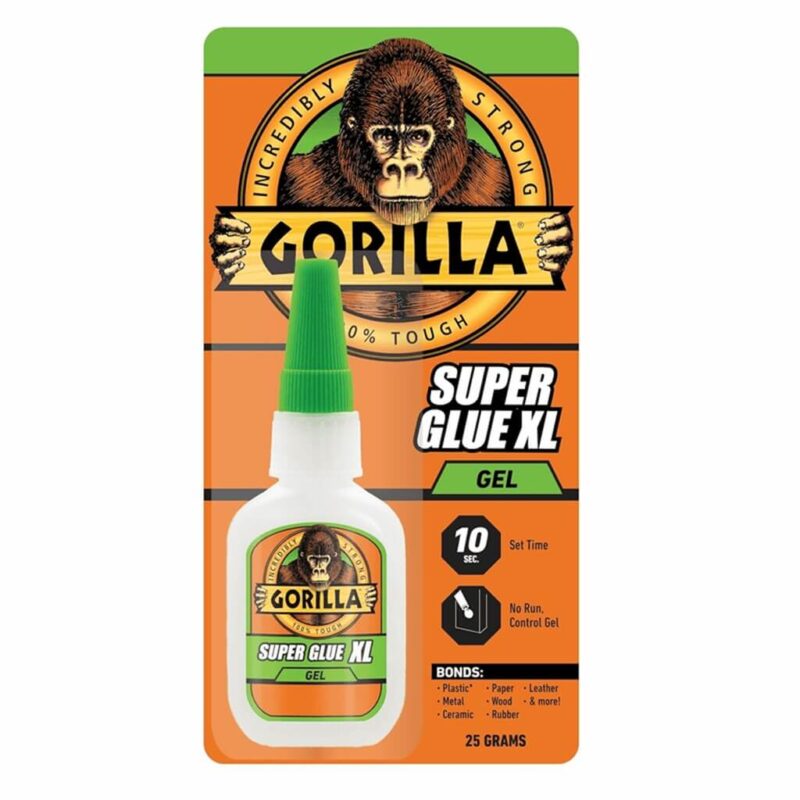
For most everyday repairs, Gorilla Super Glue Gel is one of the best glue for resin statues to recommend. Its gel consistency offers better control than traditional liquid super glue, making it well suited for repairing resin models, figurines, and decorative crafts where excess adhesive can easily ruin the finish.
- Pricing: From $11.94, available on Amazon
- Adhesive type: Cyanoacrylate (CA) gel
- Bond strength: Strong for everyday repairs; reinforced for impact resistance
- Working time: 10 to 45 seconds before the bond sets, depending on surface and glue amount
- Full cure time: 24 hours for maximum strength
- Finish: Dries clear
- Waterproof or water-resistant: Not waterproof, so avoid it on pieces that get washed or displayed outdoors
- Best for: Quick, clean breaks on resin statues, models, and crafts that stay indoors. Skip it if the piece will sit outside or get wet regularly, and skip it on polyethylene or polypropylene plastic parts, since the gel won’t bond well to those.
- Use cases: clean breaks on statues and models, general craft repairs, bonding resin to wood, metal, ceramic, or paper
- Compatible materials: plastic (except polyethylene and polypropylene), wood, metal, ceramic, paper, rubber
What buyers on marketplaces and our team think of this resin glue
- From our team’s POV: Working with cured epoxy resin has taught us that ease of application can be just as important as bond strength. Gel-formula CA glue stays where it’s applied instead of running across polished resin surfaces, making it easier to control when repairing decorative pieces with visible details. That extra control often means less cleanup and a cleaner-looking repair. The Gorilla glue can be the best glue for resin miniatures due to its strength, actually.
- From buyers’ POV: It is a popular choice because it’s affordable, easy to find, cures quickly, and performs reliably for common household and hobby repairs. As a matter of fact, lots of people from Facebook groups and Reddit have recommended this glue for resin.
Gorilla 2-Part Epoxy (Strongest Glue for Resin)
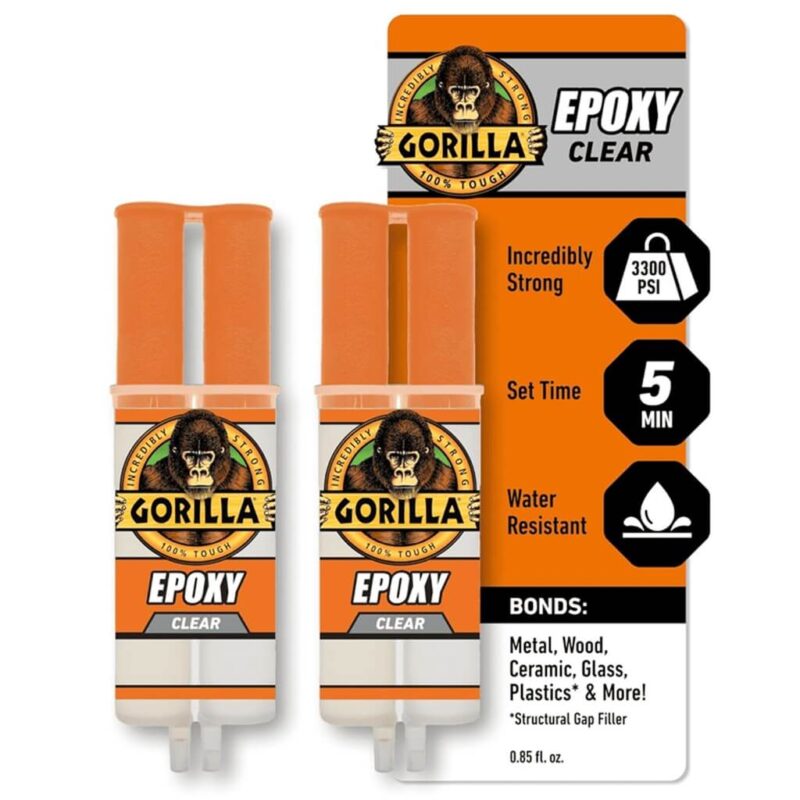
When maximum bond strength is more important than curing speed, Gorilla 2-Part Epoxy stands out as one of the strongest glue for resin products on the market. Its two-part formula creates a durable structural bond that performs exceptionally well on heavy resin statues, mixed-material projects, and repairs that need to withstand long-term handling.
- Pricing:
- Adhesive type: Two-part epoxy (resin and hardener, syringe-dispensed)
- Bond strength: High; built for structural and load-bearing repairs
- Working time: 5 minutes to mix and apply before the epoxy starts thickening
- Full cure time: 30 minutes for handling strength, 24 hours for full load-bearing cure
- Finish: Dries clear
- Waterproof or water-resistant: Water- and solvent-resistant once fully cured
- Best for: Heavy resin statues, structural breaks, and repairs that need to bear weight or survive rough handling. Skip it for tiny, delicate pieces where a visible glue line or excess epoxy would be hard to clean up, since epoxy is less forgiving of a shaky hand than gel super glue.
- Use cases: heavy statues, structural repairs, bonding resin to metal, wood, or ceramic where strength matters more than speed
- Compatible materials: metal, plastic, wood, ceramic, glass, masonry
What buyers on marketplaces and our team think of this resin glue
- From our team’s POV: Do you know that structural repairs benefit from having a few minutes to align broken pieces before the adhesive cures? That’s where a two-part epoxy has a clear advantage over fast-setting super glue. The additional working time allows for more accurate positioning, especially on larger or irregularly shaped resin pieces.
- From buyers’ POV: This resin glue needs a lot of patience since 24 hours can be a lot. However, the stronger bond and gap-filling ability make the wait worthwhile for repairs that need to support weight or withstand repeated handling.
KISREL UV Resin Adhesive (Best for Jewelry Making and Repairing)
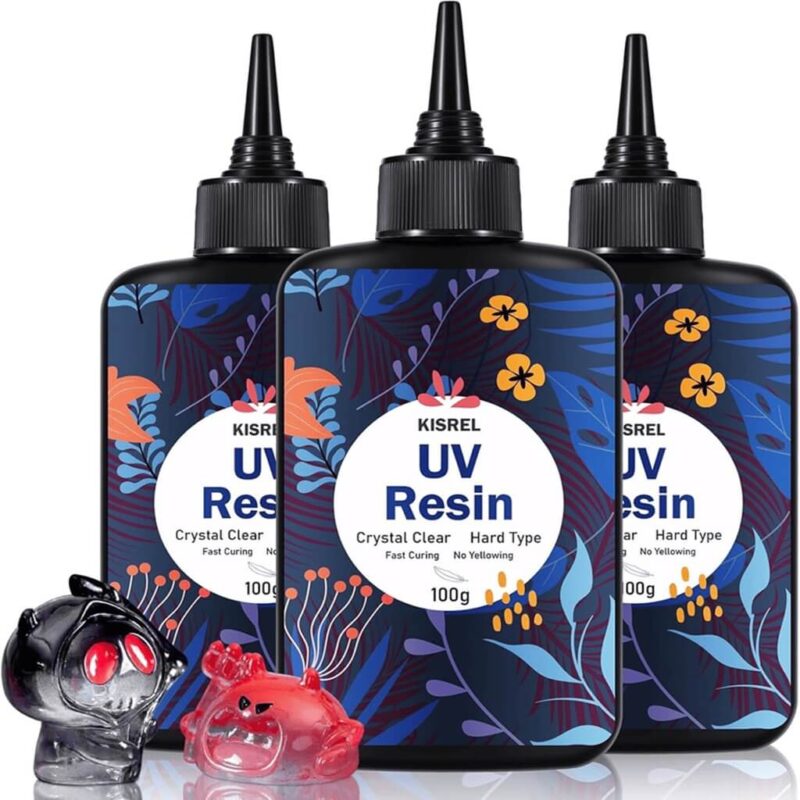
If you’re primarily repairing resin jewelry or making small decorative pieces, KISREL UV Resin Adhesive is one of the best glue for resin options to consider. Its crystal-clear finish, low odor, and controlled curing process make it well suited for detailed work where appearance matters just as much as the strength of the bond.
- Pricing: From $9.99, available on Amazon
- Adhesive type: UV-curing resin
- Bond strength: Good for lightweight jewelry and decorative bonds
- Working time: Stays liquid until cured under UV light
- Full cure time: 1 to 3 minutes under a 36W UV lamp
- Finish: Crystal clear, non-yellowing
- Waterproof or water-resistant: Water-resistant once cured
- Best for: Jewelry makers repairing pendants, earrings, and small resin castings. Skip it for large statues or structural repairs, since it’s formulated for fine detail work rather than heavy loads.
- Use cases: jewelry repair, small resin castings, keychains, decorative pieces
- Compatible materials: resin, glass, acrylic, plastic
What buyers on marketplaces and our team think of this resin glue
- From our team’s POV: We are well aware that appearance becomes especially important on jewelry and small decorative pieces because even a tiny glue line is much easier to notice than it would be on a larger project. That’s one reason UV resin continues to be popular for these repairs. You can carefully position the parts before curing, producing a cleaner finish with less risk of misalignment.
- From buyers’ POV: They definitely appreciate KISREL’s relatively low odor compared with older UV resin formulations, making it more comfortable for hobbyists working at a craft table or in smaller indoor workspaces. Like other UV-curing adhesives, however, it still requires direct UV exposure, so it isn’t the best choice for deep joints or hidden repair areas where light cannot reach the adhesive.
HeyClear UV Resin (Best for Small DIY Resin Projects)
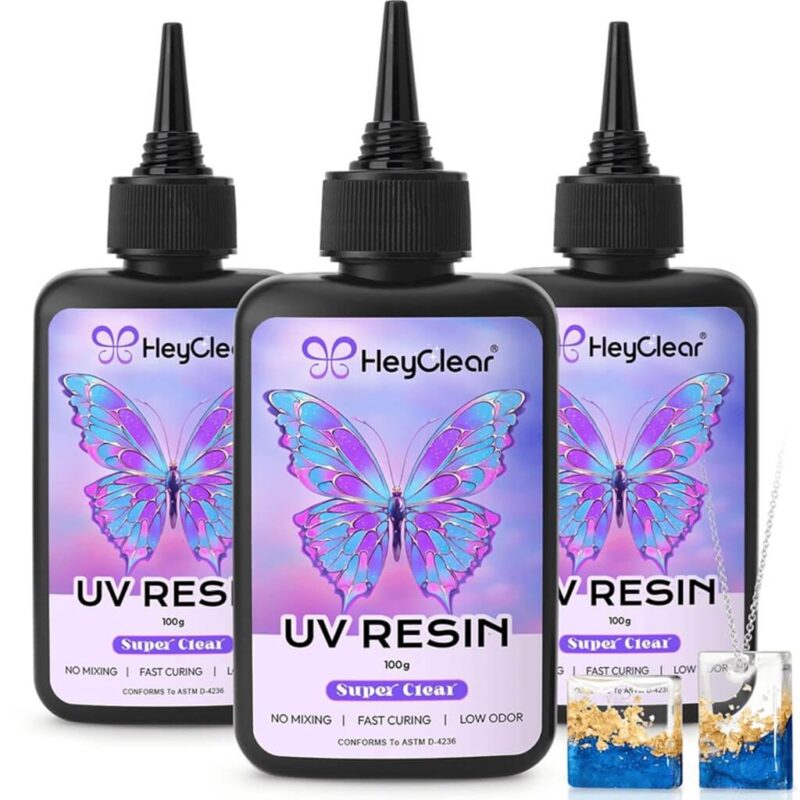
For beginners exploring resin crafts, HeyClear UV Resin offers a convenient introduction to UV-curing adhesives. Rather than purchasing separate tools, the kit bundles many of the essentials together, making it an accessible option for hobbyists working on keychains, coasters, and other small DIY resin projects.
- Pricing: From $11.99, available on Amazon
- Adhesive type: UV-curing resin
- Bond strength: Good for lightweight, small-scale bonds
- Working time: Stays liquid until cured under UV light
- Full cure time: Minutes under the included UV lamp
- Finish: Crystal clear, resists yellowing, minimal shrinkage during cure
- Waterproof or water-resistant: Water-resistant once cured
- Best for: Beginners and small-batch crafters working on keychains, coasters, and small decorative pieces. Skip it if you need a fast, one-and-done repair on a larger piece, since kits are sized for smaller projects.
- Use cases: small DIY crafts, keychains, coasters, beginner jewelry projects
- Compatible materials: resin, glass, acrylic, plastic
What buyers on marketplaces and our team think of this resin glue
- From our team’s POV: When introducing someone to resin crafting, we often find that simplicity is just as valuable as performance. A complete kit removes much of the uncertainty around choosing compatible accessories, allowing beginners to focus on learning techniques rather than sourcing multiple tools before starting their first project.
- From buyers’ POV: Buyers often mention that including the UV lamp and basic accessories makes the kit easier to use straight out of the box, especially for small creative projects. If your goal is to experiment with resin crafts or complete occasional DIY repairs, this kit provides a practical starting point.
Starbond EM-02 (Fastest Curing Time for Fine Cracks)
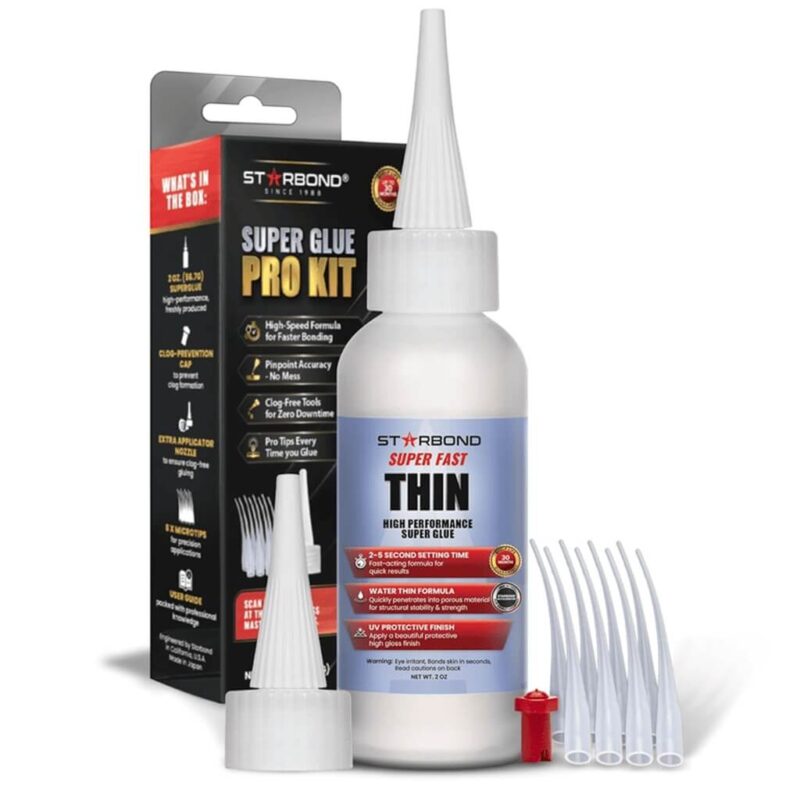
- Pricing: From $14.79, available on Amazon
- Adhesive type: Thin cyanoacrylate (CA) glue
- Bond strength: Strong for porous or textured surfaces, not designed as a general-purpose gap-filler
- Working time: Minimal; this is a fast-wicking, watery-thin formula
- Full cure time: 2 to 5 seconds without an accelerator
- Finish: Cures crystal clear, can be layered and buffed into a glossy “CA finish”
- Waterproof or water-resistant: Resistant to moisture once cured
- Best for: Hairline cracks, fine seams, and porous or textured resin surfaces where the glue needs to wick into the damage rather than sit on top of it. Skip it for wide gaps or missing chunks, since the thin viscosity runs rather than fills.
- Use cases: hairline cracks, fine seam repairs, stabilizing porous or textured resin surfaces
- Compatible materials: resin, wood, ceramic, glass, stone
What buyers on marketplaces and our team think of this resin glue
- From our team’s POV: Not every repair requires the strongest adhesive. Fine surface cracks often benefit more from a glue that can penetrate the damaged area than one that simply creates a thick bond on the surface. That’s exactly where a thin CA glue like Starbond EM-02 stands out.
- From buyers’ POV: Experienced hobbyists, model makers, and woodturners frequently recommend Starbond because of its excellent capillary action. Instead of pooling on the surface like thicker adhesives, it flows into narrow cracks and bonds from within. That’s something standard gel super glue and two-part epoxy simply aren’t designed to do.
Loctite Ultra Gel Control (Best Gel for Larger DIY Projects)
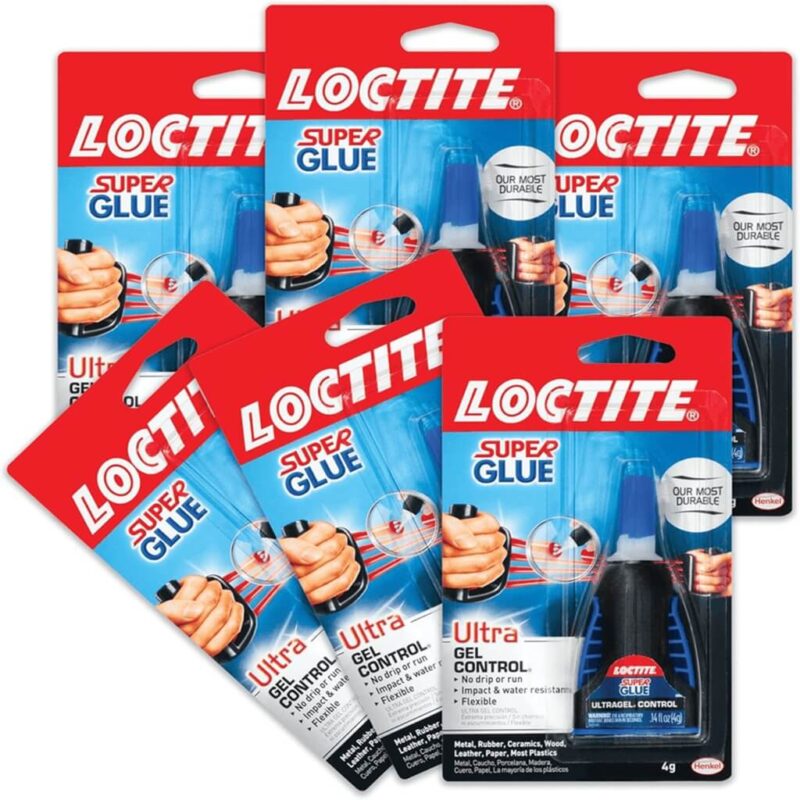
For larger DIY repairs that need to withstand everyday handling, Loctite Ultra Gel Control maybe the best glue for resin that balances strength with ease of application. Its rubber-toughened formula provides greater impact resistance than many standard super glues, making it a practical choice for functional resin pieces rather than purely decorative display items.
- Pricing: From $4.04, available on Amazon
- Adhesive type: Rubber-toughened cyanoacrylate (CA) gel
- Bond strength: High; resists impact, shock, vibration, and temperature extremes
- Working time: Sets in about 1 minute, giving slightly more repositioning time than standard super glue
- Full cure time: 12 to 24 hours for full cure
- Finish: Dries clear
- Waterproof or water-resistant: Outdoor-safe and resistant to moisture and freezing temperatures
- Best for: Larger DIY resin projects and pieces that will see daily handling, temperature swings, or outdoor display. Skip it for bonding resin to glass, since Loctite specifically doesn’t recommend this gel for glass surfaces.
- Use cases: larger craft projects, figurines, pieces subject to daily wear, outdoor resin decor
- Compatible materials: leather, cork, paper, cardboard, wood, metal, ceramic, rubber, and hard plastics such as acrylic, polycarbonate, and PVC (not recommended for glass, polystyrene foam, or polyethylene/polypropylene plastics)
What buyers on marketplaces and our team think of this resin glue
- From our team’s POV: Some projects experience far more stress than others. Decorative display pieces may only need a clean repair, while functional resin items that are picked up, moved, or handled regularly benefit from adhesives that can better absorb small impacts over time. That’s where rubber-toughened CA glues have an advantage over standard super glue formulations.
- From buyers’ POV: Loctite Ultra Gel Control is frequently praised for maintaining a reliable bond on projects exposed to vibration, temperature changes, and everyday handling, making it popular for larger DIY crafts and functional resin items.
How to Choose the Best Glue for Your Resin Project?
Even after narrowing down the best glue for resin, choosing the right one depends on your specific project. The same adhesive that works perfectly for a resin miniature may not provide enough strength for a heavy statue or mixed-material repair.
Before making your choice, focus on these two factors:
- Match the adhesive to the type of repair, whether you’re fixing a clean break, filling a gap, or repairing delicate resin miniatures.
- Balance working time, bond strength, and finish based on your project. Some glues cure in seconds for quick repairs, while others give you more time to reposition parts and create stronger structural bonds.
Match the glue to your repair
| Repair type | Best glue category |
| Hairline cracks | Thin CA glue (Starbond EM-02) |
| Clean breaks | Standard CA gel (Gorilla Super Glue Gel, Loctite Ultra Gel Control) |
| Missing pieces or gaps | Two-part epoxy (Gorilla 2-Part Epoxy) |
| Heavy statues | Two-part epoxy |
| Miniatures | CA gel or UV resin |
| Jewelry | UV resin (Akisey, KISREL, HeyClear) |
| Outdoor resin | Rubber-toughened CA gel or epoxy |
Consider the materials you’re bonding
- Resin to resin: most CA glues, UV resin, and epoxy all work well
- Resin to wood: CA glue or epoxy, both bond well to wood’s porous surface
- Resin to metal: epoxy holds up best under stress; CA glue works for lighter parts
- Resin to acrylic: UV resin is a strong option since acrylic is often transparent
- Resin to glass: UV resin works well here; check the label on CA gels first, since some (like Loctite Ultra Gel Control) aren’t recommended for glass
Pro Tip: Before committing to a major repair, verify that your base chemistry isn’t degraded. Read our guide on does resin expire to ensure your resin materials are fully stable.
Think about curing speed vs. working timef
Fast-setting CA glue is the better choice when you need a quick fix and the pieces align easily on the first try. Slower-curing epoxy gives you a few minutes to adjust position, which matters more on complex breaks where getting the alignment right the first time is difficult. If a piece needs repositioning, reach for epoxy or UV resin, both of which give you control over timing that CA glue doesn’t.
Decide whether appearance or strength matters more
For visible repairs on display pieces, a glue that dries clear and can be sanded or polished smooth (UV resin, thin CA glue) will matter more than raw strength. For structural repairs where the piece needs to survive handling or weight, epoxy’s strength outweighs the slightly longer cure time.
What Are The Best Practices for Gluing Resin Successfully?
Prepare the surface before gluing
Clean off dust, oils, and any residue from the break. Lightly sand glossy resin surfaces with fine-grit sandpaper so the adhesive has something to grip instead of sliding across a smooth, cured finish.
Use the right amount of adhesive
Flooding the joint with too much glue delays curing and weakens the bond. Apply thin, even layers instead. With CA gel, one drop per square inch is usually enough.
Hold or clamp parts while curing
Small parts can often be held by hand for the initial set. Larger or heavier pieces benefit from a clamp or tape to keep them still. Any movement during the initial cure weakens the bond before it has a chance to fully set. Check our breakdown on how long does it take for resin to harden to understand how temperature impacts curing times.
Allow the adhesive to cure fully
There’s a difference between the initial set, when the piece can be handled lightly, and full cure, when the bond reaches maximum strength. Waiting the full cure time, even when the piece feels solid sooner, makes the repair last longer under stress.
Hide glue lines on visible repairs
Sand and polish the repaired area once the adhesive has fully cured. A thin layer of UV resin can fill tiny surface imperfections left after sanding. On painted resin models, a small touch-up with matching paint over the repair line finishes the job.
Here are some common mistakes to avoid
- Gluing dirty or glossy surfaces without cleaning or sanding first
- Choosing a glue that isn’t rated for the materials involved
- Using too much adhesive, which weakens rather than strengthens the bond
- Stressing or handling the joint before it’s fully cured
- Expecting UV resin to cure in spots the UV light can’t reach
Looking for Hassle-Free Collectibles? If repairing broken figures or dealing with sticky DIY messes is taking the joy out of crafting, check out our BitCraftArt epoxy lamp collections and explore our unique custom diorama resin lamps built to last for decades.
Best Glue for Resin: Frequently Asked Questions
What is the best glue for resin?
Gorilla Super Glue Gel is the most reliable all-purpose choice for common resin repairs, thanks to its fast set time and reasonable price. For jewelry and fine detail work, UV resin kits like Akisey or KISREL give more control.
What is the strongest glue for resin?
Gorilla 2-Part Epoxy offers the highest bond strength on this list and is the best choice for heavy statues or structural repairs.
Can you glue broken resin back together?
Yes. Cured resin, whether epoxy, UV, or polyurethane-based, can be repaired with CA glue, epoxy, or UV resin, depending on the type of break and the finish you want.
Is super glue or epoxy better for resin repairs?
Super glue works best for quick, clean breaks that align easily. Epoxy is better for structural repairs, gaps, or heavier pieces where strength matters more than speed.
Can UV resin be used as glue?
Yes. UV resin stays liquid until exposed to UV light, which makes it useful for precise, low-mess bonds, particularly on jewelry and small transparent or semi-transparent parts.
Does Gorilla Glue bond to resin?
Gorilla Super Glue Gel and Gorilla 2-Part Epoxy both bond well to cured resin. Gorilla’s original polyurethane glue is less commonly used for resin repairs since it expands as it cures, which can distort a fine repair.
